

One of the biggest misconceptions about family estrangement is that people do it lightly.
For many, the reality is far more painful…
The truth is, most people don’t create distance because they stopped caring. They do it after years, sometimes decades or even an entire lifetime, of trying to make the relationship work.
The tragedy of estrangement is that it’s often not a choice between connection and distance. It’s a choice between preserving a relationship and preserving yourself.
In this video, I talk about why the growing backlash against estrangement misses that reality, and why what looks like ruthless rejection from the outside is often deep heartbreak on the inside.
If you’ve ever struggled with the guilt, grief, or bittersweet relief that comes with creating distance from someone you love, I hope this conversation helps you feel less alone.
Let me know in the comments whether you’d like me to dive deeper into the guilt, grief, and heartbreak that often come with estrangement.
Matthew Hussey:
In the last year I have noticed a troubling trend, a wave of backlash against those who have decided to cut ties with their family, in some cases, separating from family members is being billed as the oversensitive product of a woke culture that made people break up with their families over a difference in values or beliefs.
Others have positioned it as running away from doing the work that we need to do in order to be able to handle or even resolve our differences, that the spiritually whole path lies in negotiating the difficulties with that person with a new level of equanimity, or even in discovering new found peace and forgiveness within that relationship. Some of these messages are from truly well-meaning people. Some are from people who have a dangerous lack of experience in the area they’re talking about.
And I think sometimes it comes from people who have a personal interest in shaming those who become estranged from their family because they are the very kind of person one would wish to become estranged from. I am Matthew Hussey. I have been a coach for over 18 years of my life helping people build confidence, heal from the past and develop relational intelligence. Please subscribe to this channel if you want to see more content from me and like this video. So the other people who need it will see it.
Today, I want to talk about the virtues of estrangement and why the notion that this is simply an extreme response by people who have a stunted ability to deal with differences in relationships is not just a distraction, but dangerous. Let’s first get this out of the way.
Oh, there’s some people who cut off their parents or their families for reasons that defy rationality and more later, regret it. Of course, there are also those who do it because of a genuine personality disorder, where the intention behind it is at best ignorant and devoid of empathy, and in some cases even malicious or sadistic, a way to punish family members by freezing them out or making it so that parents don’t get to see their grandchildren.
I believe the majority of people who decide to become estranged from someone as foundational as their own parents fit a very different profile. Most who do become a strange do so an extraordinary pain threshold at the point of realizing that having that person in their life is incompatible with living a happy, peaceful life, and many do so at great social cost to themselves.
These people have reached the ceiling of their pain tolerance, which is merciful because many, maybe even most, never do, and the consequences are long and tragic.
In these situations, the intentions behind estrangement are totally different.
They have nothing to do with malice or wielding some kind of power over the family member in question. Most never even feel they’ve had power in that relationship at all. In fact, with the relationship in question, many have felt totally powerless, sometimes even afraid for most if not all, of the relationship.
Many cannot bring themselves to hate the person they’re separating from. Regarding of how deeply they’ve been hurt by them and for how long don’t wish them ill. They may, even, against all odds, still want the best for the person they no longer have contact with.
But they have come to realize that they cannot have someone capable of this level of destruction or abuse close to them anymore, because to do so would be a terrible betrayal of themselves, of their human. As we put it on my retreat, it is a feeling of waking up out of a trance, of misplaced familial responsibility into a new found responsibility to take care of a self that they are now paying attention to and have realized they are responsible for. Usually the same people have attempted for some considerable portion of their lives, perhaps the majority of their lives, to have a relationship with the person in question.
But at some point the directive had to change.
It’s no longer how do I keep this person in my life? But how do I ensure that this person, who continues to be a malignant presence in my life, no longer has access to this person that I care about myself? For some, that means that while I accept we will never be close, I will stay in contact with this person. Life circumstances sometimes make that necessary.
In other cases, it means I can’t be in contact with this person at all because there is no version of being arm’s length with them. That doesn’t still destroy my piece in life. Either way, the goalpost shifts from connection to protection, and the gross oversimplification that this idea only applies to victims of sexual and physical abuse is a fatal misunderstanding of what psychological and emotional abuse can do to a person, and also of the nature of coercive control.
Coercive control is silent. It can do extreme psychological, emotional, financial, and even physical damage and take many years, sometimes a lifetime of recovery. People who reached this point, are usually people who have found to their utter devastation that the concept of closure and catharsis is nothing but a fantasy for them. They may, in certain moments harbor a blind hope for catharsis, but with a clear head they know deep down that there is no catharsis to be found anywhere in these situations.
The only closure they have access to is the piece that they find in this person’s absence.
And when people do remain in contact with a person like this in their life, there is often a very specific set of calculations they make for doing so. And it isn’t about catharsis or working through something with this person, or using it as a growth lesson for oneself.
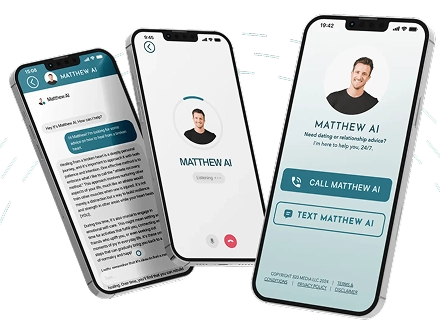
The people who leave these situations aren’t simply snowflakes who cannot handle a minor disagreement. And to suggest that that is what is going on is an incredible straw man. Letting go of family members is, for most people, the most unnatural thing in the world they will ever have to do, especially when it comes to someone as foundational as a parent. For anyone who is going through something akin to what I’m talking about in this video. I really want to urge you and encourage you to go and talk to Matthew AI.
I know that many of you will think of this as a tool for your dating lives, but people don’t realize the power of this for some of the most difficult things in your life.
I’ve had people who were struggling for years to break away from someone in their life. And Matthew AI finally helped them get the strength internally to do it. Or maybe you’ve already done it and you have incredibly complex emotions around having done it. Whether it’s guilt, sadness, grief, hot break. You don’t know if you’ve done the right thing.
Please go talk to Matthew AI, promise you, it is one of the most valuable resources I can recommend for this. You can find it at AskMH.com. Just give it a go. That’s all I ask.
The problem for most people who fit this profile is not that they created distance too soon, it’s that they did it too late, and it is often an intensely private thing, far from something that’s done for attention. Many don’t even feel they can talk about it either, because it’s too painful, or because they don’t even know how to begin to explain the complexities behind why it is they cannot have this person in their lives, which is why it’s so intensely painful when someone who doesn’t know the inner workings of this relationship says something like, but there’s still your mum, but there’s still your dad, your brother, your sister.
People may say this about parents, siblings, even children, which of course is a uniquely complicated tragedy for some parents.
These are the kinds of stock phrases that shame people who have already had to do. One of the hardest things to do, including phrases like blood is thicker than water. If you are someone who, at great pain and great cost, have had to distance yourself from someone in your life, never forget that people who say things like this are generally sitting on the outside of the relationship, and by shaming people for going no contact, they are preaching something fundamentally dangerous.
And by the way, sometimes they even know the person you have broken contact with, but that doesn’t mean they have had any of your experiences with them. Some of life’s most pernicious narcissists are undetectable, even to their friends, while the family at home suffer by being under the same roof as them.
This is the reason that highly trained therapists like my friend Doctor Ramani, suggest that victims of narcissistic abuse find a therapist who is trained in narcissism. Even well-meaning people who have not educated themselves on the true nature of these kinds of people can be truly dangerous in helping you to decide your next move.
People inside these systems who attempt to reconcile the irreconcilable to harm not just to their minds, but to their bodies destructive people. Let’s remember our form of chronic stress and chronic stress will create problems first in your mind, and then if you do nothing to alleviate it, your body.
Chronic stress is a cause of disease and is ultimately a killer for so many. Look, I want to be clear about something. There are obviously many people who cut ties with certain members of their family, not out of necessity, but out of a level of reactive ness that doesn’t serve them. These people May 1st day benefit from reconciliation, from moving past their own judgment and anger.
But we should be very careful when dealing with an otherwise loving, caring individual not to rush in with platitudes about the value of making peace with family. Instead, it might be worth asking first what is going on here that has this person feeling they had to do one of the most impossible, difficult things to do?
Because you know what’s better than being out of contact with your mum? Being in contact with your mum? You know what’s better than having to break up with your dad? Not having to break up with your dad? So? How and why has this person gotten to this point? For so many who become estranged, their resolution about that decision will be mistaken for anger or even hatred. But what there is in fact is devastation. Grief, true grief. And that grief is about the relationship they wish they had with that person.
If you are estranged from someone, remind yourself that the core of what you’re feeling is most likely heartbreak. And that is even harder when the person that you have become estranged from is still alive, because you worry about how one day you will regret not having spoken to them while they are still here. But you also know that having a relationship with them doesn’t work, so you go round and round in circles between what feels like two impossible positions.
The truth of estrangement is that it does not feel like some kind of victory. It is bittersweet relief.
The reality is not the feeling of having won. It is deep, deep sadness that often leaves people in a perpetual state of guilt and grief that they have to continuously work through. Where the progress made is anything but linear. Grieving is messy. Bit by bit. You grieve the vision you had for what the relationship could have been.
There’s an internal death and realizing that in fact, it couldn’t have been because that’s not who they are.
You grieve the memories. You’ll never create together, the landmark life moments you’ll never share. You grieve the idea of ever being seen by them while they’re still around. And in some cases, you even grieve the history you thought you had with that person while you may find a greater peace in your life of distance from this person, there may always be something bittersweet about that peace. Because it’s not the peace you asked for. Rather, it was the only peace that was available to you as the psychiatrist Judith Hermann observed, recovery can take place only within the context of relationships.
It cannot occur in isolation that our deepest pain and ultimately our salvation, is that in our particular case, our healing cannot will not come from the same relationship that caused us to break in the first place. If you would like to see a follow up video where I dive deeper into how to deal with the guilt and the pain of these situations.
Two things one. Leave me a comment below letting me know, and I will get to work on making that video for you, I promise. But two you are exactly the kind of person that would benefit profoundly from joining me on my retreat in October. That is the deepest work I do. It is so relevant to what we are talking about here, and I genuinely hope to see you there.
I will leave a link to the retreat tickets page below. In the description. Check that out. And as always, I will see you next week.
*This transcript was whipped up with the help of AI. While it does a pretty impressive job, it may have the occasional typo, mix-up, or moment of creative interpretation. If you spot anything that looks a little . . . adventurous . . . thanks for your patience (and your sense of humor).*





Hi Matthew,
Yes, I am interested in another video. Also, at your retreats, I was wondering is there times wihen we break into groups and discuss things? I have never been to one of your retreats. Is it more than one day, do I have my own room,etc….?
Thank you,
Sandee
Detect your cheating partner and catch them redhanded in their sneaky ways when you contact RemoteSpytech (at)Gmail, c0m who rescued me. He’s the real deal
I’ve been estranged from my son for over 2 years now, following an aggressive outburst on his part. He told me he hated me when I asked why he was always so angry towards me despite all the help and encouragement/support I’ve given during his adult years.
It causes me great pain and continual heartbreak to be disconnected to a child I love dearly and I fear it will remain this way. Equally I appreciate during his younger years, I wasn’t the most present or connected parent so I can see why he would feel the way he does, even if I also feel I’ve made up the mistakes I made. But that’s only half the story isn’t it and I can only imagine what it was like for him, because I live through my eyes and not his.
Maybe one day we will reconnected. All I know is, i am here for it!! Endlessly hoping our connection can be repaired ☺️
I strongly recommend you reach out to RemoteSpyTech (at)G mail, c0m if you want to catch your suspected cheating partner redhanded in their sneaky ways. This is the best tech personnel to hire, he’s the real deal
Boy did this article (and video) hit the nail on the head.
Please comment on what happens when the person we have cut off from (to save ourselves) is one of our parents, and what happens when that parent dies…
Thank you.
This week’s video was spot on as to how I feel about not having a relationship with my mother. Thank you for making it.
Thank you so much for making this video. I would love to see a follow up. I am a few weeks into cutting off contact with a very toxic aunt who I’ve had a close relationship with through my whole life. I relate so well to the bitter-sweet relief of not having that negative influence in my daily life and the chronic stress it carried. I had been blind to the degree of emotional manipulation, lies, and overall toxic negative energy. When my request for boundaries in the process of changing my people-pleasing, toxic empathy behaviors (shout out to my therapist) was not respected, I felt I had no choice but completely block contact to put taking care of my human first (shout out to Love Life and Mathew Hussey). :) Thanks for doing what you do, Mathew! Always learning and evolving one insight at a time…
Your deep knowing and clear understanding of what this ‘situation’ is truly about, and what it takes to eradicate oneself from its destructive claws is such a gift to me. It took me decades, and at tremendous psychological, emotional, and physical cost, but I did the work, and am now free, and at peace. I have no regrets. Your words are the first I’ve heard over all the decades of what felt like crawling on glass that have supported me in my decision – MY knowing. Feels so good. Thank you.
Please add me to your mailing list.
Yes please Matthew. I would love to know more about this situation and how to find peace in having estrangement with family members.
Yes Matthew, I would like to know more about estrangement with family (mom, & siblings)as well close friends.
Thank you for the video. It hit home for me , now it’s to release some guilt for having let go although having abandonment issues.
A more-than decade-long follower here (you helped me meet my husband 11 years ago!). Clearly, you have lived and grieved through entrangement from the inside to have these things to say about it. Thank you for this, and for all of the wisdom you have shared over the years. This *all* rang true for me.
I really need help with the grief and heartbreak I’ve been dealing with. I had to cut ties with my father last August. I confronted him about past abuse and manipulation. He disowned me and said some very nasty things. It’s a long story and I do have a therapist. My parent divorced when I was 10. My mother is also very toxic and I cannot be around her. I have been in recovery for almost three years now. I have a very supportive and loving boyfriend but I’m not sure I’m capable of love. Im a single mom of three and just very exhausted in every way. I need help.
Have you been cheated on by your trusted partner and being taken for a fool and you want to uncover the truth about your partner. Wait no more, kindly contact RemoteSpytech(at)Gmail,c0m to get the right help and thank me later. He’s the real deal
Dear Matthew,
Thank you for being such a lovely, insightful and compassionate human being.
I have been estranged from my mother for more than two years now. It was a very hard decision to make, and I, indeed, got the cliche comments – “you will be sorry, she is your mother, and there’s only one mum”. Thank god there is only one! – I think. This one was a destructive enough force in my life. Somehow, luckily, I grew up into a sensible person. I’ve tried talking and compromising with her for years and years. It was like doing emotional double back flips. After decades of trying, I concluded she is just absolutely incapable of any kind of caring relationship. It does show in the rest of her life, too, so I really don’t think it’s just with me. In any case, “bittersweet” is the best kind of adjective one could use here.
Thank you for being so sensitive and understanding of this subject :) I rarely take the time to explain any of this to anyone, and I am just glad for the people who deeply can’t get what this decision actually took for me or anyone in a similar situation.
Contact RemoteSpytech (at)Gmail, c0m if you want to catch your suspected cheating partner on their unfaithful ways. This is the real deal and I was able to get the peace of mind I ever wanted.
It’s interesting how this topic shows that love and separation are not always opposites. A person can still care deeply about someone while recognizing that the relationship is harful to their well being!